Stored XSS in Firewall Rules/NAT pages via a HTML-attribute breakout
| CVSS 3.1: | 5.4
(Medium) CVSS:3.1/AV:N/AC:L/PR:L/UI:R/S:C/C:L/I:L/A:N
| ||||||||||||||||
| Software: | OPNsense | ||||||||||||||||
| Published: | 01.07.2026 | ||||||||||||||||
| CVE: | CVE-2026-58391 ↗ | ||||||||||||||||
| Credits: | Jonas Ampferl | ||||||||||||||||
| External Advisory: | Check out the external advisory ↗ |
Summary
The Firewall Rules and NAT pages build tooltips using the title="${...}" HTML attribute with attacker-controlled free-text via string concatenation.
Two such free-text fields, a Firewall Category name and a Firewall Alias description, allow double-quote characters, because used htmlspecialchars (which encodes < > &) function leaves " and ' untouched.
The surviving double-quote closes the title attribute and injects an event handler onto the existing <span>, yielding a stored XSS.
A low-privileged user, who can edit a category or an alias is able to store cross-site scripting payloads that runs in the session of any user/administrator, opening the Firewall Rules or NAT pages.
| # | Field | Sink |
|---|---|---|
| A | Category name | filter_rule.volt:481 (title="${name}"), nat_rule.volt:386 (${cat.name}) |
| B | Alias description | filter_rule.volt:619-621 and nat_rule.volt:448 (title="${tooltipHtml}") |
Details
Root Cause
All session-client API output is wrapped in htmlspecialchars($json, ENT_NOQUOTES). ENT_NOQUOTES encodes < > & but not "/'.
The grid formatters place the field value inside an HTML attribute built by JS string concatenation:
// filter_rule.volt line 480-481 (category) and the identical pattern at nat_rule.volt line 385-386
<span class="category-icon" data-toggle="tooltip" title="${name}"> // name = cat.name (NOT escaped)
// filter_rule.volt line 619-621 (alias) and the identical pattern at nat_rule.volt line 448
const tooltipHtml = aliasInfo.summary || aliasInfo.description || aliasInfo.value || "";
return `<span data-toggle="tooltip" data-html="true" title="${tooltipHtml}">${aliasInfo.value} </span> ...`;
The value arrives with </> entity-encoded (so a new <script>/<img> tag cannot be opened), but the surviving " lets the attacker close title and add an event handler to the existing <span>.
Proof of Concept
Authenticated as a low-privileged firewall operator (Firewall: Categories or Firewall: Alias: Edit).
Both payloads below use onanimationstart, which requires zero interaction to being triggered.
The globally-loaded highlight keyframe is loaded, leading to the handler firing automatically, when the user opens the page.
The trailing x=" keeps the surrounding markup well-formed so the row renders normally.
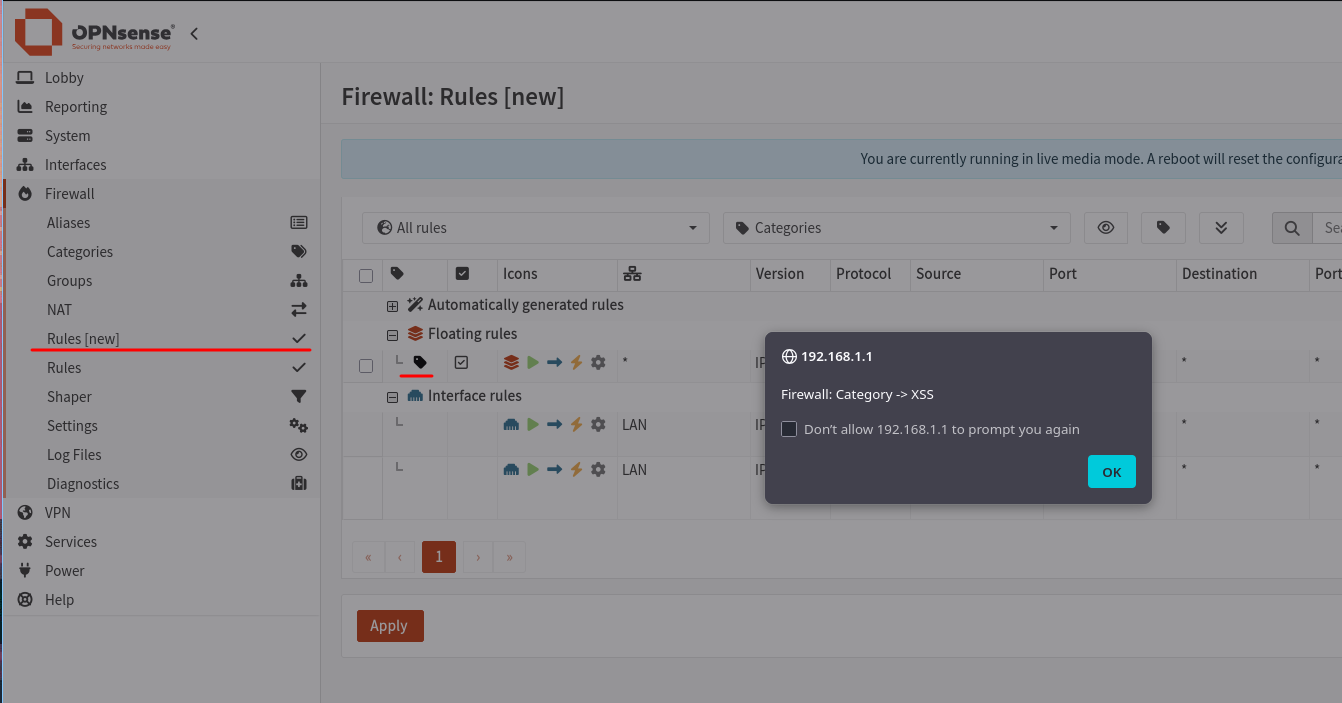
(A) Category name - Firewall -> Categories -> +
Set the name to:
" onanimationstart="alert('Firewall: Category -> XSS')" style="animation:highlight 1s" x="
Assign the category to any filter/NAT rule, save, then open Firewall -> Rules (and Firewall -> NAT) -> the handler fires on render.
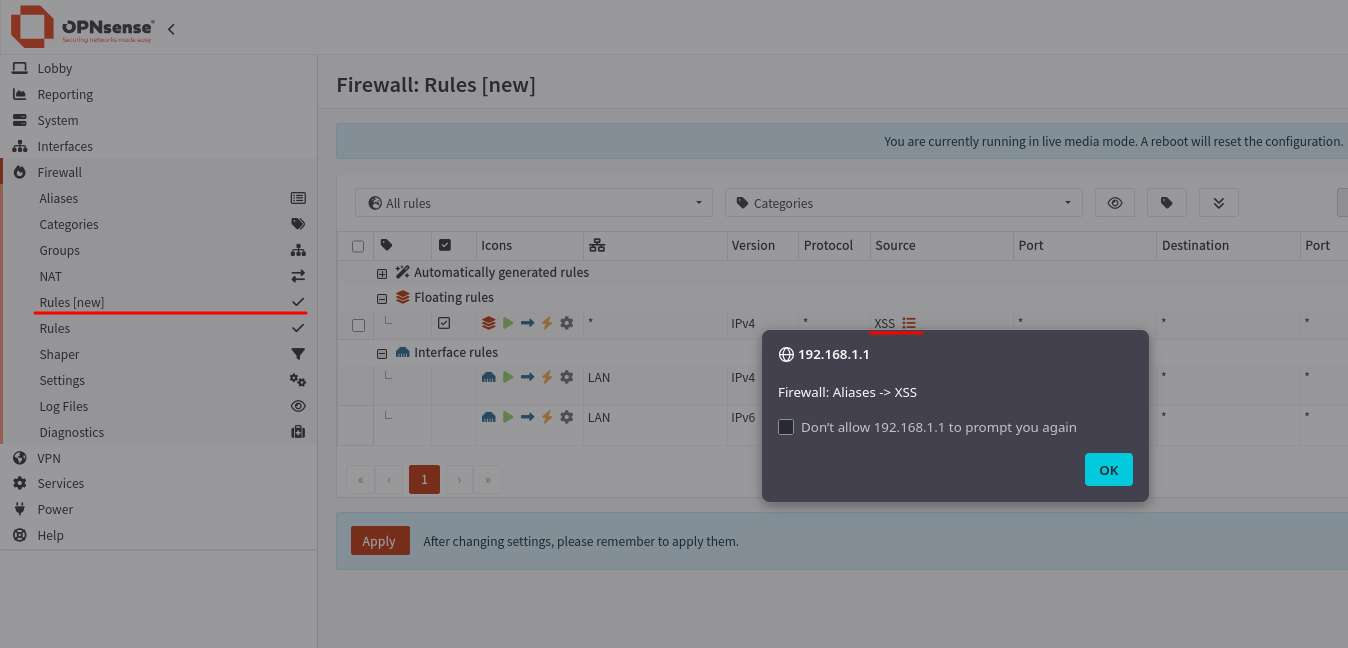
(B) Alias description - Firewall -> Aliases -> +
Set the description to:
" onanimationstart="alert('Firewall: Aliases -> XSS')" style="animation:highlight 1s" x="
Reference the alias in a rules Source or Destination, save, then open Firewall -> Rules (and NAT) -> the alias tooltip span renders the handler and it fires on load.
Impact
A low-privileged firewall operator (category or alias edit only) can store javascript that executes in the authenticated GUI session of any user/administrator who views the Rules or NAT pages. That permits theft of the CSRF token and execution of authenticated actions as the victim.
References
Könnte deine Anwendung auch Lücken haben?
In unserem Hacking Cult Bootcamp durchläufst du in 4 Wochen einen strukturierten Security-Check. Von Grundlagenwissen, um zu prüfen, wo dein Team wirklich steht, bis hin zum konkreten Schwachstellen-Scan deiner Webanwendung. Und das komplett kostenlos!


